Driving across Tempe, it’s easy to see how the ground changes. Near Mill Avenue and Arizona State University, the soils tend to be older alluvial deposits mixed with decades of urban fill—unpredictable stuff. Head south toward the Kyrene area, and you hit expansive clays that swell after a monsoon storm. You can’t treat these sites the same way, and that’s precisely where a soil mechanics study becomes the first real engineering decision on a project. We’ve worked across enough Tempe lots to know that the USGS soil survey maps are a starting point, not the final word. The lab index properties and the field behavior under load are what actually dictate foundation type and slab reinforcement. Before pulling permits, many contractors coordinate a soil mechanics study with an in-situ permeability test when stormwater infiltration basins are part of the site plan, especially in the lower terraces near the Salt River where drainage design gets complicated fast.
The difference between a standard geotech report and a thorough soil mechanics study is knowing the swell pressure, not just that the soil expands.
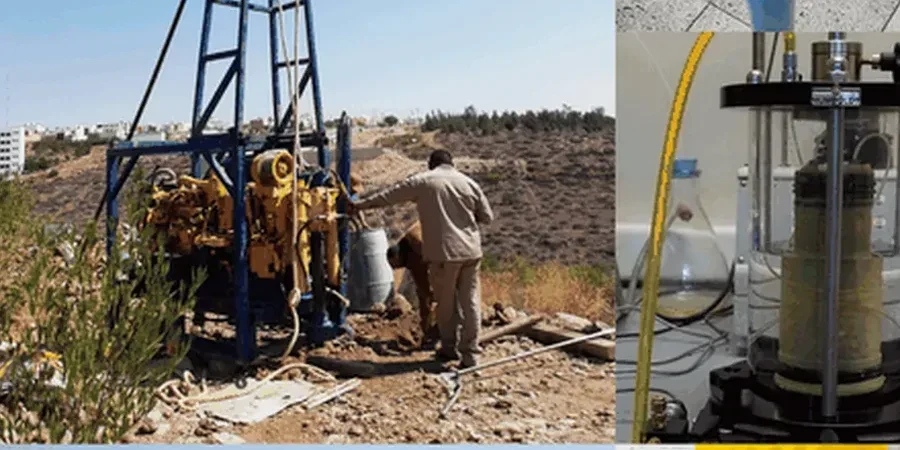
Scope of work in Tempe Arizona
Risks and considerations in Tempe Arizona
Tempe sits at roughly 1,180 feet elevation in the Salt River Valley, and while the seismic hazard from nearby fault zones is generally lower than coastal California, the bigger risk here isn’t shaking—it’s volume change. The city’s population has grown past 190,000, pushing development into areas underlain by the Tempe Clay unit, a stiff, overconsolidated clay that can heave with enough force to crack grade beams and tilt retaining walls. A soil mechanics study that skips the swell-consolidation testing or misidentifies the active zone depth leaves the structural slab vulnerable to edge lift and center heave. We’ve seen distress in tilt-up warehouses less than five years old where the geotech report simply classified the material as “sandy lean clay” without measuring expansion index. The Arizona Geological Survey’s mapping of the basin-fill deposits helps guide the initial boring layout, but the lab data from a soil mechanics study is what keeps the warranty period from turning into a legal headache.
Our services
A soil mechanics study in Tempe rarely stands alone. Most projects benefit from targeted field testing that refines the laboratory parameters and confirms construction quality. These are the two supplementary activities our clients request most often when developing in the East Valley:
Swell and Consolidation Testing Suite
Full ASTM D4546 swell/collapse potential and ASTM D2435 consolidation curves on undisturbed Shelby tube samples. We report percent swell, swell pressure, compression index, and preconsolidation stress so your structural engineer can design for volume change with confidence.
Field Density and Moisture Control
Nuclear gauge and sand cone density testing during fill placement and subgrade preparation. We verify compaction to 95% of modified Proctor maximum per the project specifications, with real-time reporting to keep the earthwork contractor moving without rework delays.
Quick answers
What does a soil mechanics study cost for a typical single-family lot in Tempe?
For a standard residential parcel under 10,000 square feet, a soil mechanics study with one boring, Atterberg limits, swell testing, sulfate analysis, and a signed foundation recommendation letter runs between US$3,380 and US$5,990. The range depends on access constraints, depth to refusal, and whether we run additional consolidation or corrosivity panels.
How deep do you drill for a soil mechanics study in the East Valley?
Typical exploration depth in Tempe is 15 to 25 feet below existing grade for low-rise structures. We extend deeper—sometimes 40 feet or more—when the stratigraphy suggests deep alluvial lenses, when liquefaction analysis is required, or when a basement level is in the plans. The boring depth is always tied to the zone of influence of the proposed foundation.
What’s the difference between a soil report and a soil mechanics study?
A basic soil report gives you classification and a presumptive bearing value. A soil mechanics study goes further: it quantifies strength parameters, compressibility, swell potential, and chemical reactivity through laboratory testing. It gives the structural engineer the numbers needed for settlement calculations, slab reinforcement design, and sulfate-resistant concrete specification.
How long does it take to get results from a soil mechanics study in Tempe?
Field drilling and sampling usually take one day. Laboratory testing—particularly consolidation and swell tests that require multi-day soaking phases—adds seven to ten business days. We deliver the draft geotechnical report with foundation recommendations within two weeks of mobilizing the drill rig, and we can expedite certain tests if the grading contractor is waiting on a compaction spec.