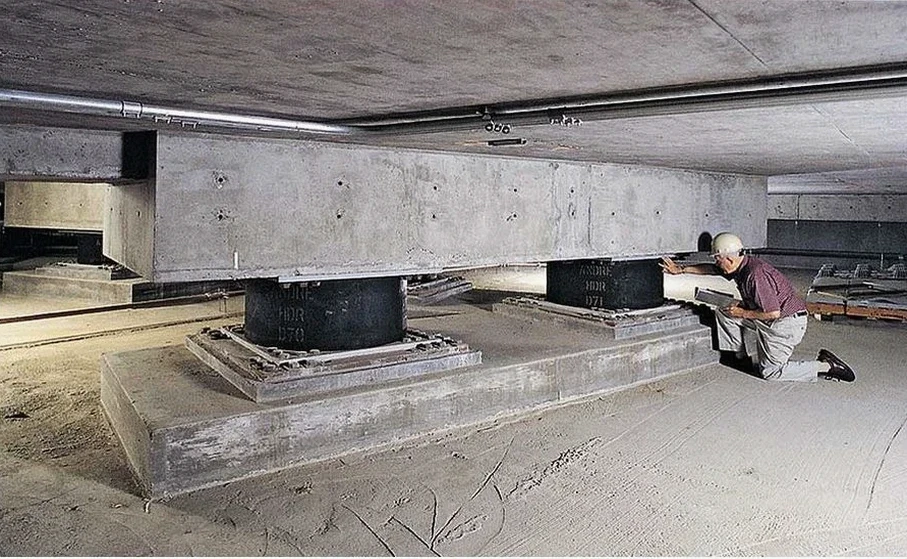
ASCE 7-22 Section 17 establishes the analysis procedures for seismically isolated structures. In Tempe, Arizona, this becomes critical due to the city's position within the Basin and Range Province. The area sits near several Quaternary faults, including segments of the Salt River fault zone. Ground motion amplification occurs in the alluvial basin, where deep sedimentary deposits overlay bedrock at depths exceeding 1,000 feet in some locations. The seismic isolation design process requires site-specific response spectra per Chapter 21 of ASCE 7. Our technical team develops isolation systems using high-damping rubber bearings, lead-rubber bearings, or friction pendulum devices. The selection depends on the structural period shift required and the displacement capacity needed. For critical facilities in the city, we often combine site response analysis with isolation design to optimize performance. A detailed geotechnical investigation using seismic refraction helps map the bedrock profile and shear wave velocities that govern input motions.
The isolation period must be tuned to the basin's fundamental frequency. Get it wrong, and the structure amplifies motion instead of decoupling from it.
Scope of work in Tempe Arizona
Risks and considerations in Tempe Arizona
Contractors in Tempe sometimes underestimate the vertical component of near-fault ground motions. The 2015 Black Canyon earthquake swarm reminded everyone that moderate events can generate significant peak vertical accelerations. Isolation bearings that handle horizontal displacement beautifully can fail under combined tension and shear if vertical effects are ignored. Another risk we see repeatedly: property modification factors applied without site-specific prototype testing. The code permits default values, but the Salt River Valley's alluvial stratigraphy produces frequency content that doesn't match generic assumptions. Wind loading also demands attention. The isolation system must remain rigid under the 10-year wind per ASCE 7 but yield under seismic forces. For slender structures in Tempe, the wind lock-up design can govern the bearing selection. We reference the 2024 IBC amendments adopted by the city, which require peer review for isolated structures over four stories. That review process catches design flaws that isolated analysis might miss.
Our services
Our Tempe-based technical support covers the full isolation design workflow. Each phase addresses specific requirements of the local regulatory environment and subsurface conditions.
Site-Specific Response Spectra Development
Generation of design response spectra per ASCE 7-22 Chapter 21 for the Tempe basin. Includes probabilistic and deterministic seismic hazard analysis using USGS NSHM data and local fault databases.
Nonlinear Time History Analysis
Three-dimensional structural modeling with explicit bearing elements. Seven ground motion pairs selected and scaled per ASCE 7 requirements. Envelope results for bounding property cases.
Prototype Testing Specification
Preparation of test protocols aligned with ASCE 7-22 Section 17.8. We coordinate with ISO 17025 accredited laboratories for full-scale bearing testing, including aging, velocity, and temperature dependency.
Quick answers
What does base isolation add to the structural cost?
For a mid-rise project in Tempe, the isolation system including bearings, moat covers, and utility disconnects typically ranges from US$3,660 to US$7,520 depending on the floor area and number of isolators. The cost is offset by reduced member sizes in the superstructure.
How does the IBC regulate base isolation design?
IBC 2024 Section 1705 requires special inspection of seismic isolation systems. The design must follow ASCE 7-22 Chapter 17. The City of Tempe also mandates peer review for isolated structures over four stories as part of the permitting process.
Can an existing building in Tempe be retrofitted with isolation?
Yes, though it requires a moat excavation around the building and temporary jacking of the structure. The feasibility depends on the foundation type and the building's structural continuity. We have evaluated several campus buildings near Arizona State University for such retrofit.
What ground motions govern the design for a Tempe site?
We use site-specific spectra derived from crustal fault sources in the Basin and Range. The controlling scenario often comes from a moderate magnitude event on a nearby fault rather than a distant large event, due to near-fault directivity effects.
How are isolation bearings tested for quality assurance?
Prototype testing covers three full-scale bearings per type, per ASCE 7 Section 17.8. Production testing checks 100% of bearings at design displacement. Our specifications follow ASTM D4014 for elastomeric bearings, with tests conducted at ISO 17025 accredited facilities.