Specifying rigid deep foundations across the whole site is the most expensive mistake we see in Tempe. Much of the Salt River Valley has compressible silts and loose sands that look terrible on a raw SPT blow count, but they respond extremely well to stone column reinforcement. The real problem is the near-surface caliche—that cemented layer can fool a drill rig into refusal if the crew isn’t watching the torque, and then you get a design based on incomplete data. We look at the whole profile: the soft clays below the caliche, the groundwater that fluctuates with the canal releases, and the structural loads coming from tilt-up concrete or steel frame buildings. When the stratigraphy allows it, a CPT test gives us continuous tip resistance and sleeve friction that picks up thin soft seams an SPT spoon might miss. For industrial slabs and warehouse footings, we often combine the stone column grid with a plate load test on the treated ground so the EOR has a modulus of subgrade reaction they can actually use in the slab design. Our approach cuts foundation costs 30 to 50 percent compared to drilled piers on many Tempe sites.
A well-designed stone column grid in the Tempe basin can reduce settlement by 60 to 80 percent without the cost of drilled shafts.
Scope of work in Tempe Arizona
Risks and considerations in Tempe Arizona
Ground conditions shift dramatically between the Kiwanis Park area and the industrial corridor west of Priest Drive. Kiwanis sits closer to the old Salt River channel with thick alluvium and a high water table—stone columns there are almost always wet-installed and we design for lateral drainage so pore pressures dissipate quickly during the improvement phase. Over by Priest and University, you hit the caliche hardpan shallow, and if you misread that as bearing stratum without probing deeper, the columns won’t transfer load past the crust into the compressible layer below. The consequence is differential settlement that cracks slab-on-grade within two monsoon seasons. We run in-situ permeability tests on the native silts before finalizing the drain path design, because a clogged column turns into a stiff inclusion that attracts more load than intended. In the Tempe context, ignoring the drainage function is the fastest way to turn an economical ground improvement into a forensic engineering file.
Our services
Our Tempe stone column work covers the full design-through-verification cycle. We do not just hand over a column layout and walk away—we stay involved through the test phase to confirm the improvement ratio matches the model.
Settlement Reduction Design
Priebe-based analytical design with 3D FEM verification for column grids under isolated footings, strip footings, and mat foundations. We match area replacement ratio to allowable settlement criteria, usually 1 inch total and ½ inch differential for most Tempe commercial slabs.
Liquefaction Mitigation with Stone Columns
Drainage-centric design for liquefiable sands mapped in the Salt River corridor. We size the column spacing to limit excess pore pressure buildup during the design earthquake per ASCE 7-22, using Seed & Idriss triggering curves calibrated to the site-specific CPT data.
Quick answers
What does stone column design cost for a typical Tempe commercial lot?
Design fees for a stone column ground improvement package on a standard Tempe commercial lot generally fall between US$1,300 and US$4,980, depending on the number of borings or CPT soundings we need to interpret, the complexity of the column grid, and whether 3D finite element modeling is required. A small retail pad with uniform soil and two borings lands near the lower end; a large warehouse with variable stratigraphy, high groundwater, and structural eccentricity pushes toward the upper range.
How do you verify that the installed stone columns meet the design intent?
We specify a pre- and post-improvement CPT program: run a CPT sounding at the centroid of a column triangle before installation, then run another CPT in the same location after the column is built and the ground has had time to equilibrate. The increase in tip resistance and sleeve friction tells us the improvement ratio directly. For bearing elements, we add a plate load test on a column group to confirm the modulus of subgrade reaction.
Can stone columns be used when caliche layers are present near the surface?
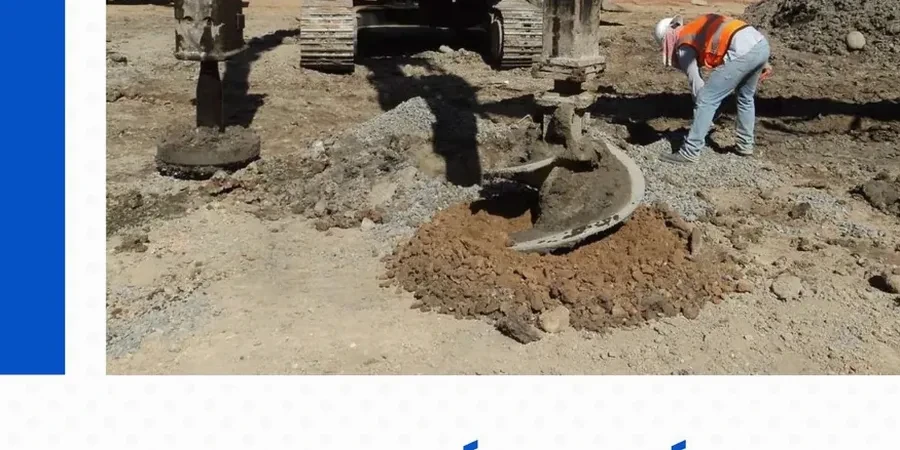
Yes, but the design has to account for the caliche explicitly. The vibro probe will punch through the caliche if it is less than about 3 feet thick and not fully cemented. If the caliche is thicker, we pre-drill through it with a short auger section so the bottom-feed system can reach the compressible layer below. The key is not mistaking caliche refusal for competent bearing—our CPT data distinguishes between a thin crust and a true dense stratum.