One of the most persistent errors we see in Tempe basin projects is assuming that standard penetration resistance alone can predict how silty-clayey soils will behave under long-term loading. Tempe sits on a complex alluvial fan where interbedded layers of sand, silt, and clay—deposited by the ancestral Salt River—can consolidate unevenly when saturated by monsoon rains or irrigation seepage. A conventional investigation may flag a borderline bearing capacity, but without a triaxial test program, the designer cannot quantify the effective friction angle or pore pressure response that governs settlement calculations. Our laboratory runs consolidated-undrained (CU) and consolidated-drained (CD) triaxial tests following ASTM D4767 and D7181, giving structural and geotechnical engineers the drained and undrained shear strength parameters they need to model foundation performance accurately. For projects near Arizona State University or along the Loop 101 corridor where excavation depths exceed 15 feet, we often combine these tests with a CPT investigation to map stratigraphy continuously before selecting undisturbed samples for triaxial testing.
A single consolidated-undrained triaxial test on Tempe basin clay can reveal an effective friction angle five degrees higher than empirical SPT correlations would suggest—data that often reduces foundation costs by eliminating unnecessary overdesign.
Scope of work in Tempe Arizona
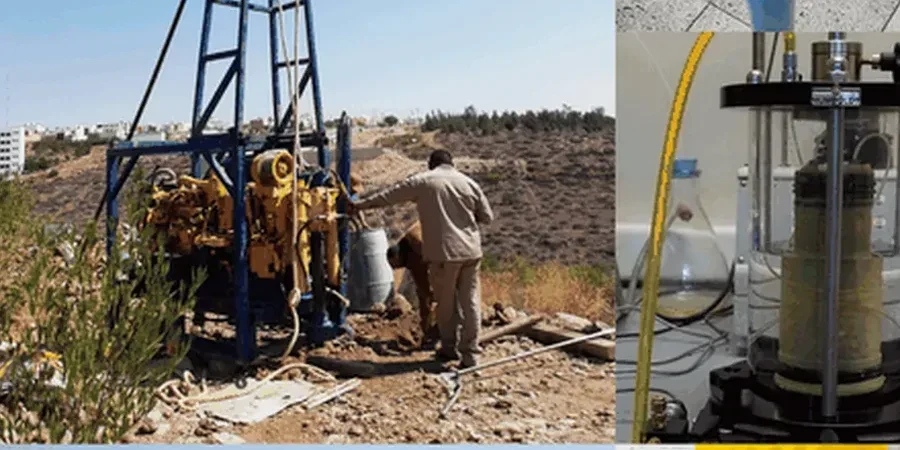
Risks and considerations in Tempe Arizona
IBC Chapter 18 and ASCE 7-22 Section 12.13 require site-specific shear strength data when designing in Seismic Design Category D, which covers most of Maricopa County including Tempe. The risk of using generic published correlations for triaxial parameters becomes acute in the Salt River floodplain, where Holocene-age deposits can exhibit contractive behavior and flow liquefaction under seismic shaking. Seed and Idriss established the framework linking cyclic stress ratio to soil behavior decades ago, but applying it demands laboratory-measured cyclic triaxial or monotonic undrained strength data from the actual project site. A structure founded on Tempe alluvium without triaxial-derived strength parameters risks differential settlement exceeding 2 inches during a design-basis earthquake, a performance level that can shear underground utilities at the building line. For critical facilities—fire stations, data centers, campus research buildings—the triaxial test program is not optional; it is the only defensible method to satisfy the IBC's requirement for a rational analysis of seismic soil-structure interaction.
Our services
We offer the following triaxial testing configurations for Tempe projects, with sample preparation and reporting handled by a laboratory that maintains AASHTO re:source and AMRL proficiency program accreditation for soil strength testing.
Consolidated-Undrained (CU) Triaxial with Pore Pressure
Multi-stage CU testing on 2.8-inch diameter specimens with back-pressure saturation to B-bar ≥ 0.95. Effective stress Mohr-Coulomb envelopes reported with c' and φ' parameters. Applicable to foundation bearing capacity analysis and slope stability modeling in Tempe's interbedded alluvium.
Consolidated-Drained (CD) Triaxial Testing
Slow shear rate CD tests for free-draining granular soils encountered in Tempe's upper 15 feet. Volume change measured via burette or digital transducer. Drained friction angle φ' typically ranges from 33° to 38° for Salt River sands, but site-specific values can deviate substantially.
Unconsolidated-Undrained (UU) Quick Triaxial
UU testing on 1.4-inch Shelby tube specimens for rapid evaluation of undrained shear strength Su. Used during early-stage excavation design for Tempe projects where saturated clay layers at depth require shoring design parameters within 48 hours of sampling.
Quick answers
What does a triaxial test cost for a Tempe project?
A single triaxial test (CU with pore pressure measurement) on an undisturbed Shelby tube sample typically ranges from US$2,130 to US$2,650 per specimen, depending on the number of consolidation stages and whether a full stress-strain report with Mohr-Coulomb plots is needed. Most Tempe projects budget for a suite of three specimens to bracket the expected confining stress range at foundation depth.
Which triaxial test type do I need for a shallow foundation in Tempe?
For shallow footings and mat foundations in Tempe's alluvial soils, a consolidated-undrained (CU) test with pore pressure measurement is the standard choice. It provides effective stress parameters c' and φ' for long-term drained analysis, while also capturing undrained strength for short-term loading during construction. If the bearing stratum is clean sand above the water table, a consolidated-drained (CD) test may be more appropriate.
How long does triaxial testing take from sample delivery to report?
A standard CU triaxial test with three confining pressures typically takes 7 to 10 working days. The consolidation phase alone can require 24 to 48 hours per stage for low-permeability Tempe clays. UU quick tests are faster, with results available in 2 to 3 days. We coordinate sample pickup from Tempe drill sites daily to minimize moisture loss and disturbance.
Can triaxial testing help evaluate liquefaction potential in Tempe?
Yes, cyclic triaxial testing directly measures the cyclic stress ratio required to trigger liquefaction in saturated sands and silty sands. Tempe lies within the Salt River floodplain, where loose Holocene deposits between 10 and 30 feet depth are susceptible to seismic liquefaction. Monotonic undrained triaxial data can also be used with Seed-Idriss simplified procedures to estimate the factor of safety against flow failure.