Tempe’s growth from a small agricultural stop on the Southern Pacific Railroad to a dense urban core brought unique challenges for vertical grade changes. The city’s expansion onto Quaternary alluvial fans deposited by the Salt River created a subsurface profile dominated by sands, silts, and gravels—materials that demand precise lateral earth pressure calculations. A grain-size analysis of these granular deposits often reveals a lack of cohesion, which drives the selection of the right retaining wall design. Our team works with these local soil conditions daily, applying pressure diagrams that reflect the actual friction angle of the Tempe basin fill rather than generic textbook values.
In Tempe’s granular basin soils, a one-foot rise in the water table can double the overturning moment on a cantilever wall.
Scope of work in Tempe Arizona
Risks and considerations in Tempe Arizona
The City of Tempe adopted the 2018 International Building Code with local amendments, and the average elevation of 1,184 feet means the entire city sits within the Basin and Range seismic province. The last moderate event felt locally was the 2015 Black Canyon City magnitude 4.1, a reminder that even small ground accelerations amplify lateral thrust on walls over six feet tall. Undrained backfill is the most common failure trigger we see during monsoon season—when fine-grained soil from a nearby site gets used as fill, the July storms saturate it, and the wall rotates forward. Our retaining wall design includes a drainage specification and a construction observation phase to verify that the contractor places the filter fabric correctly and compacts the structural backfill in lifts not exceeding eight inches.
Our services
We deliver a complete engineering package for retaining wall design, from the initial subsurface investigation through to stamped construction drawings tailored to Tempe’s permit review process.
Cantilever & Counterfort Walls
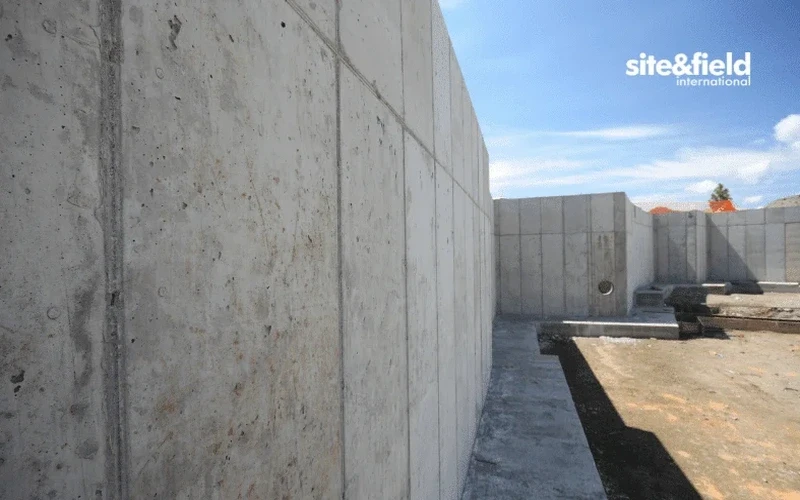
Reinforced concrete walls for grade separations up to 20 feet. We optimize the stem thickness and heel length using the actual unit weight of the Tempe basin fill, reducing concrete quantities while maintaining the required factor of safety against overturning.
MSE Walls with Geogrid Reinforcement
Mechanically stabilized earth walls using select granular backfill and high-strength polyester geogrids. Ideal for the wide approach fills along Loop 101 and 202 interchange projects where total settlement must stay under one inch.
Gravity and Segmental Block Walls
For residential lots in the foothills south of Baseline Road, we design segmental block walls with a buried course and gravel core. The design includes a site-specific global stability analysis when the slope below the wall exceeds a 2H:1V inclination.
Shoring and Temporary Excavation Support
Soldier pile and lagging walls for deep utility trenches in downtown Tempe. We coordinate with the deep excavations monitoring program to track lateral deflection during the ASU student move-in week, when adjacent sidewalks stay open.
Quick answers
What is the typical cost range for a retaining wall design in Tempe?
For a standard residential or light commercial retaining wall design—including the geotechnical investigation, laboratory testing, and the structural calculation package—the fee typically falls between US$1,200 and US$4,050. The final number depends on the wall height, the number of borings, and whether a drainage study is required.
At what height does the City of Tempe require a stamped engineering design for a retaining wall?
Under the IBC 2018 as amended by Tempe, any retaining wall taller than four feet measured from the bottom of the footing to the top of the wall requires a design sealed by a registered professional engineer. Walls supporting a surcharge, such as a driveway or a neighboring structure, require an engineered design regardless of height.
How do you account for the caliche layer in the design?
Caliche forms in discontinuous lenses across the Salt River Valley. When our borings encounter a cemented layer, we test its unconfined compressive strength. If the caliche is continuous and at least 12 inches thick, we can place the wall footing directly on it and use a higher allowable bearing pressure—sometimes double the value of the surrounding granular soil. We still check for a softer layer below the caliche to avoid a punching shear failure.