A common misstep we see in Tempe is treating all native soil like it's just sand and gravel because the surface looks dry. Dig a foot or two down, especially east of the Loop 101 near the Salt River floodplain, and you hit fat clays that swell when irrigated and shrink to dust in June. A standard sieve alone won't catch that. Atterberg limits testing tells you exactly where the soil sits on the plasticity chart—liquid limit, plastic limit, plasticity index—so you're not guessing when it's time to design footings or specify lime treatment. The lab team runs every sample per ASTM D4318, with enough repeat points to nail the flow curve, because missing a high-plasticity layer under a slab in Tempe means callbacks that cost way more than a test pit exploration ever would. We also cross-reference results with grain size distribution when the fines content is borderline, to confirm whether the material really classifies as a CH or just a silty sand with attitude.
In Tempe's basin clays, a plasticity index above 25 isn't just a lab number—it's a direct predictor of slab heave risk.
Scope of work in Tempe Arizona
Working video
Risks and considerations in Tempe Arizona
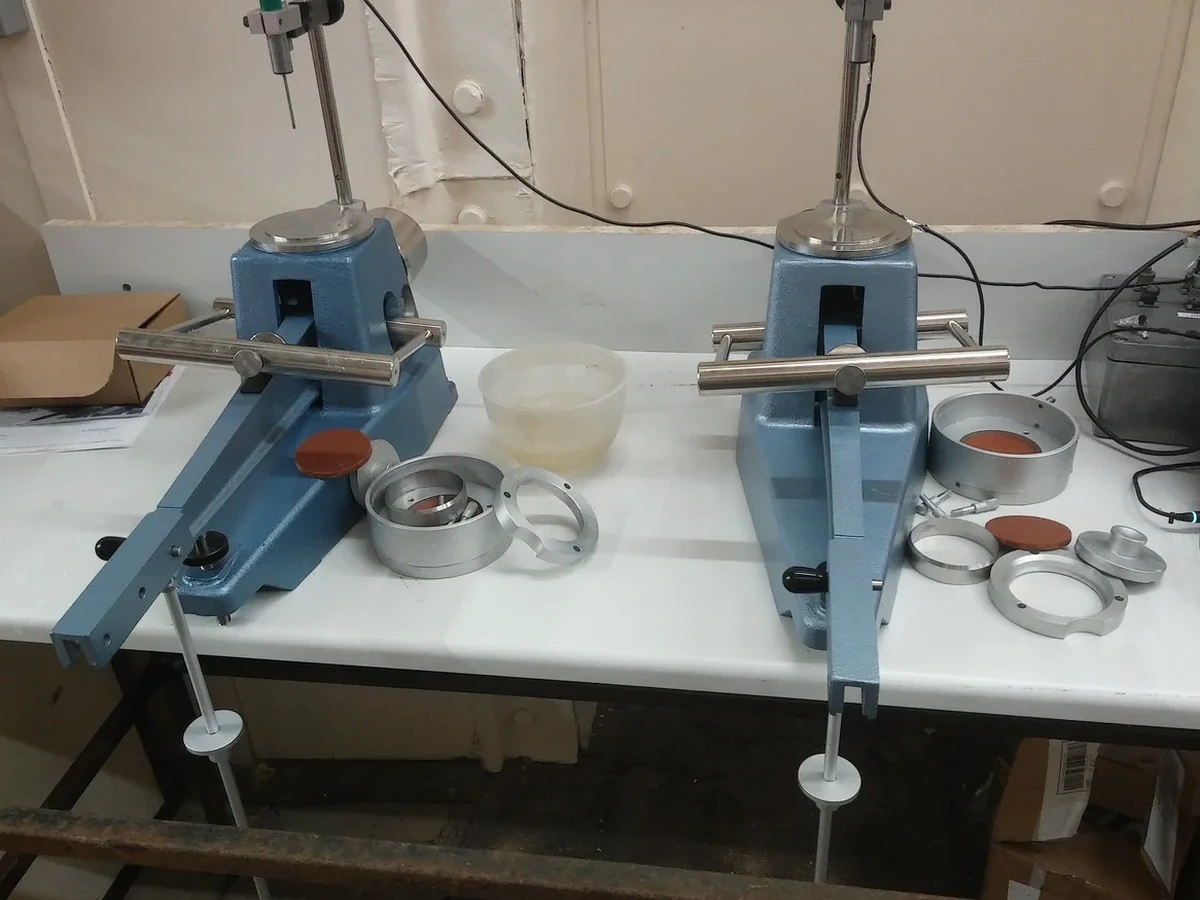
The brass cup and grooving tool on the Casagrande device look almost antique, but they're still the most direct way to measure how a Tempe clay behaves when remolded. The technician mounts the paste in the cup, cuts a clean groove with the flat tool, and cranks the handle at exactly two blows per second until the groove closes half an inch. Do that at four water contents, plot the blows against moisture, and read the liquid limit off the flow curve at 25 blows. The real risk in this city is that a sample left too long on the bench dries out and gives a false low liquid limit, so we run the test immediately after prep, keeping the lab humidity steady. If someone skips the plastic limit thread-rolling step, they lose the plasticity index, and without that number, the USCS classification is incomplete. In Tempe, an incomplete classification often means a foundation designed for SC soil when it's actually CH—and that difference shows up as cracked drywall within two monsoon seasons.
Our services
Atterberg limits are rarely the only test needed on a Tempe project. We typically bundle classification with the following activities:
Complete Soil Classification Package
Combines Atterberg limits with sieve and hydrometer analysis per ASTM D2487 to deliver a full USCS group symbol and group name, plus the AASHTO classification when needed for roadway subgrade reports.
Expansive Soil Evaluation
Uses the plasticity index together with natural moisture content and dry density to estimate swell potential and offer prescriptive recommendations for slab-on-grade design in Tempe's high-plasticity zones.
Moisture Conditioning Advice
Practical guidance on lime or cement stabilization based on the Atterberg results, aimed at reducing the plasticity index to a target value suitable for structural fill or subbase under rigid pavement.
Quick answers
How much does Atterberg limits testing cost in Tempe?
For a standard set of Atterberg limits—liquid limit, plastic limit, and plasticity index—the cost runs between US$70 and US$80 per sample when submitted as part of a routine geotechnical investigation. Expedited turnaround or single-sample walk-in requests may carry a small additional charge depending on lab workload.
How long does it take to get results back?
Standard turnaround is 3 to 5 business days from sample receipt. The multipoint liquid limit requires overnight oven drying and careful remolding, so there's a natural minimum processing time. We can often deliver preliminary plasticity index numbers within 48 hours for contractors who need to adjust moisture conditioning on site.
Why do Tempe soils need Atterberg testing if they look sandy?
Surface appearance is deceptive. Many Tempe sites have thin sandy veneers over deeper basin-fill clays deposited by the ancestral Salt River. Even when the top few feet look granular, the bearing layer or subgrade often contains enough fines to be expansive. Atterberg limits catch that hidden clay fraction, which a visual classification or simple sieve misses, and the plasticity index directly feeds into IBC expansive soil classification.