Foundation conditions shift dramatically across Tempe. A commercial lot near Arizona State University often sits on dense, cemented caliche. Move south toward the Kyrene corridor, and you encounter deeper alluvium with intermittent clay lenses. The bearing capacity changes. The corrosivity risk changes. Electrical resistivity testing cuts through that uncertainty. A Vertical Electrical Sounding (VES) survey maps these transitions without trenching or drilling blind. For developers working near the Salt River’s historic floodplain, resistivity data reveals where saturated zones might complicate excavation. We combine that data with in-situ permeability measurements when groundwater interaction is a concern. The raw numbers matter. But the interpretation of those numbers—when tied to local geology—is what prevents change orders later.
Resistivity is not just about finding water. It’s about predicting how the soil will chemically interact with buried concrete over the next 50 years.
Scope of work in Tempe Arizona
Working video
Risks and considerations in Tempe Arizona
The most expensive mistake in Tempe is assuming homogeneous soil. A contractor bids the job expecting dry, competent caliche. They hit a perched water table at 12 feet. The resistivity survey would have caught that. The resistivity contrast between dry alluvium and saturated silts is stark—often an order of magnitude difference. Skipping the survey means the dewatering plan is reactive, not proactive. Another common failure is ignoring soil corrosivity. Tempe’s agricultural legacy left behind saline soils that attack ductile iron and concrete. A low resistivity reading (< 20 Ω·m) is a direct indicator of high corrosion potential. Without that data, the structural engineer cannot specify the correct concrete cover or protective coatings. The repair costs surface within a decade.
Our services
Our Tempe survey packages are tailored to the project scale. We cover everything from single-family lot evaluations to corridor studies for linear infrastructure.
1D Vertical Electrical Sounding (VES)
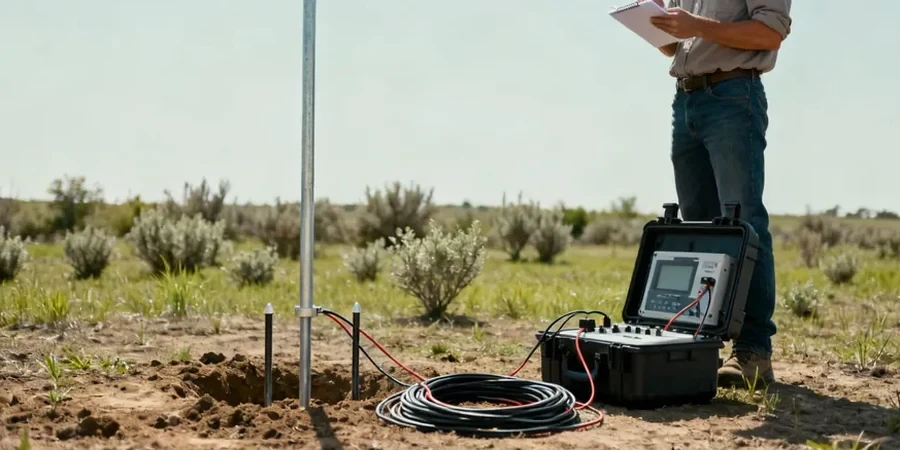
A single-point depth profile using the Schlumberger array. Ideal for determining depth to bedrock, locating the water table, or assessing soil corrosivity at a specific column location. We offer a resistivity log and a preliminary geotechnical interpretation.
2D Electrical Resistivity Tomography (ERT)
A multi-electrode profile that produces a continuous cross-section of the subsurface. This is the right choice for pipeline routes, canal embankments, or mapping lateral changes in the Salt River alluvium across the site.
Quick answers
What does a resistivity survey in Tempe typically cost?
For a standard 1D VES sounding, budgets usually fall between US$640 and US$970 depending on the maximum depth required and site access. A 2D tomography line is priced per linear foot and requires a custom scope review. We deliver a fixed-price proposal after a site walk.
How deep can you see with electrical resistivity?
The depth of investigation is controlled by the current electrode spacing. With a 400-watt transmitter and a 300-foot spread, we can reliably resolve layers down to 100 feet in Tempe’s basin-fill deposits. Deeper targets require a larger array and more power.
Why is soil corrosivity a problem in Tempe?
The valley’s history of irrigation has left behind concentrated salts in the near-surface soils. When resistivity drops below 20 ohm-meters, the soil is classified as highly corrosive. This demands thicker concrete cover, sulfate-resistant cement, or cathodic protection for steel pipelines.
Can the VES method find groundwater?
Yes. Saturated clean sands and gravels show a distinct drop in resistivity compared to dry overburden. We can map the depth to the water table and identify confined versus unconfined aquifer conditions. The data helps dewatering contractors size their well systems before breaking ground.
How long does a field survey take?
A single VES sounding takes about one hour on site. A 2D ERT line of 400 feet typically requires half a day. We schedule around construction traffic and urban noise, which is common near the ASU campus and downtown Tempe. The final report is delivered within three business days.