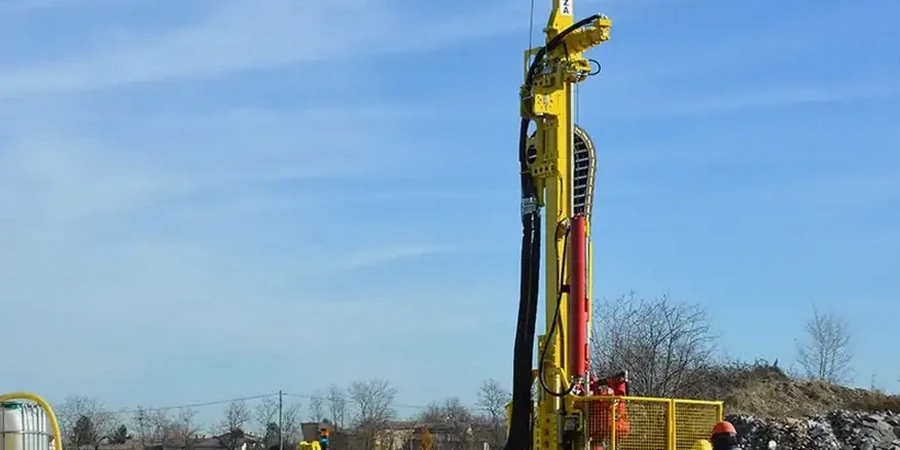
A CME-75 track rig with an automatic trip hammer drops a 140-pound weight exactly 30 inches to drive a 2-inch split-spoon sampler into Tempe’s subsurface. The operator records blows per six inches and we pull the spoon to recover a disturbed sample from each five-foot interval. With the Salt River running dry most of the year, the upper 15 feet often hide clean poorly graded sands interbedded with gravel lenses that sound hollow on the cathead until the sampler bites into a caliche crust near the Kyrene corridor. Those refusal zones—N-values jumping from 12 to refusal in one drive—are what make or break a shallow spread footing design east of Rural Road. We log every run on ASTM D1586 field forms and bag the sample for the lab, where a sieve stack confirms whether the sand is SW or SP per the unified classification. For deeper profiles below 30 feet, we often pair the SPT with a CPT sounding to catch thin silt seams that the spoon can miss in a partial sampler advancement.
N-values in Tempe’s Salt River deposits can swing from 8 to refusal in under four vertical feet — that’s the caliche ceiling and it governs foundation type.
Scope of work in Tempe Arizona
Risks and considerations in Tempe Arizona
Tempe’s north side, from Papago Park down to Tempe Town Lake, sits on coarse alluvial fan gravels with cobbles that can damage a split spoon and produce misleadingly high blow counts, while the southern tier below Guadalupe Road is dominated by finer basin-floor silts and clays that are prone to collapse upon wetting. A structural engineer who designs the same 2,500 psf bearing pressure for both areas is gambling with differential settlement. In the northern gravels, refusal at 18 inches forces a switch to drilled piers, whereas the southern silts may show N-values of 6 to 10 down to 12 feet—insufficient for a conventional strip footing without ground improvement. Our rigs are equipped with both auto-hammer and safety hammer configurations, and we record the hammer energy ratio so the geotechnical engineer can normalize the N60 and run a settlement estimate using the Hough or Schmertmann method. The IBC-mandated liquefaction screening for Seismic Design Category D sites in Tempe requires SPT blow counts to at least 50 feet, and missing a loose sand lens at 35 feet because the boring was terminated early is a liability that no amount of post-construction grouting can truly fix.
Our services
Every SPT boring we drill in Tempe feeds into a broader geotechnical program that addresses the specific requirements of Maricopa County plan review and the IBC. The two activities below are the most common next steps after the split-spoon logs are drafted.
Liquefaction Triggering & Settlement Analysis
We run the SPT blow counts through the Seed-Idriss simplified procedure, corrected for hammer energy and overburden, to estimate the factor of safety against liquefaction and the post-shaking reconsolidation settlement for the design earthquake. The output determines whether ground densification or deep foundations are required.
Bearing Capacity & Foundation Recommendation Report
Using the N60 values from the SPT log, we compute allowable bearing pressures for both shear failure and 1-inch settlement limits, applying the Terzaghi or Meyerhof equations with site-specific groundwater correction. The report specifies foundation type, embedment depth, and any caliche-cemented horizon that may serve as a bearing stratum.
Quick answers
What is the typical cost of an SPT boring program for a single-family home lot in Tempe?
For a standard residential lot requiring two to three borings to 20 feet with automatic hammer and split-spoon sampling at 5-foot intervals, the total cost ranges from US$490 to US$790, including the field log, lab grain-size curves on representative samples, and a brief letter report with bearing capacity recommendations. The price varies with access constraints, caliche thickness, and the number of samples sent to the lab for Atterberg limits.
How deep do you drill SPT borings for a commercial building near Arizona Mills?
The Maricopa County building official typically requires borings to a minimum of 30 feet or 1.5 times the building width below the foundation level, whichever is deeper. For tilt-up warehouses and retail structures near the I-10 and US-60 interchange, we commonly extend borings to 40 or 50 feet to satisfy the IBC seismic site classification requirements and to capture any loose sand lenses that could liquefy under the design earthquake.
Can SPT refusal on caliche be used as a bearing layer for drilled piers?
Yes, caliche—cemented calcium carbonate hardpan common across Tempe—frequently causes SPT refusal at N-values above 50 blows per 6 inches. When we encounter refusal on a continuous cemented horizon at least 3 feet thick and confirmed by rock-quality assessment of the recovered fragments, the geotechnical engineer can designate it as a bearing stratum for drilled piers or belled caissons, provided the layer is laterally continuous across the footprint and is not underlain by a softer zone that could cause punching failure.
How do you correct SPT N-values for the automatic hammer used on your Tempe rigs?
We apply the standard energy correction using a hammer energy ratio measured by instrumented rod tests on our CME automatic trip hammer. The raw N is multiplied by the energy ratio factor CE, the borehole diameter correction CB, the rod length correction CR, and the overburden correction CN per the Seed-Idriss (1985) and Skempton (1986) correlations. The corrected N60 is what appears on the final boring log and is used for all bearing capacity, settlement, and liquefaction calculations submitted to the county for permit review.