The contrast between ground conditions near Tempe Town Lake and those south of the US 60 is stark. Near the lake, you encounter loose, saturated silts and sands deposited by the Salt River, while areas closer to South Mountain sit on older, denser alluvial fans. A site on the north side can require a radically different approach than one near Kiwanis Park. That's why a standardized compaction plan simply doesn't work here. Our vibrocompaction design process starts with a careful review of the site-specific depositional history, correlating existing boring logs with the target performance criteria. We often find that preliminary data from in-situ permeability tests provides critical insight into drainability during the vibratory process, which directly informs probe spacing and energy input. For deeper profiles where silt content is higher, we may recommend coupling the design with stone columns to ensure drainage paths remain open during densification.
In the Salt River Valley's interbedded alluvium, a vibrocompaction design is only as good as its adaptability to rapid changes in silt content.
Scope of work in Tempe Arizona
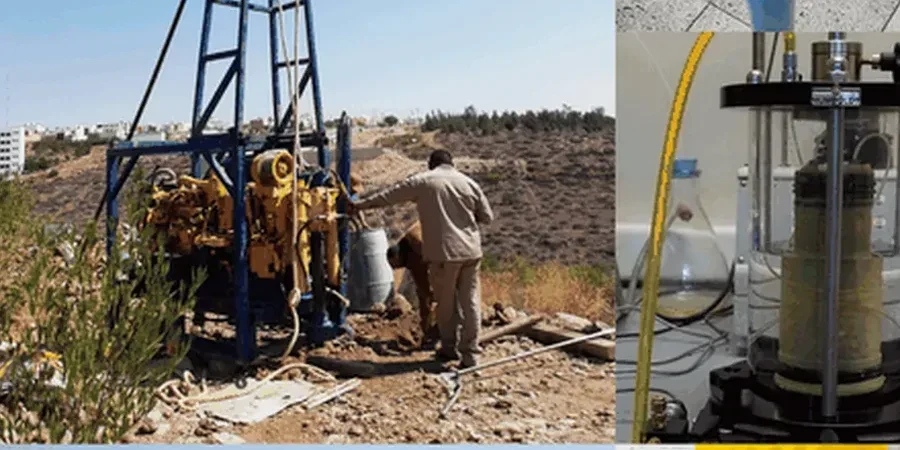
Risks and considerations in Tempe Arizona
A recurring issue we see in Tempe is the assumption that all basin-fill soils respond uniformly to vibratory energy. The presence of thin clay seams or cemented caliche layers—common in the older terrace deposits east of Arizona Mills—can reflect energy back toward the surface, reducing the effective radius of influence and leaving untreated pockets at depth. When these lenses are missed during the site investigation, the result is differential settlement that shows up as slab cracking within the first three to five years after construction. Our design process explicitly maps these discontinuities using a combination of CPT soundings and targeted borings, so the compaction grid can be tightened or supplementary pre-drilling can be specified where needed. The cost of correcting an under-designed treatment zone is an order of magnitude greater than the upfront investment in a thorough vibrocompaction design that accounts for these local stratigraphic quirks.
Our services
Our vibrocompaction design activities in Tempe span the full project lifecycle, from feasibility assessment through post-treatment verification. Each deliverable is prepared with the specific subsurface conditions of the Phoenix metropolitan area in mind.
Feasibility and Desktop Studies
We review existing geotechnical data, USGS Quaternary geology maps, and historical groundwater levels for your Tempe parcel to determine whether vibrocompaction is the appropriate ground improvement method before any field mobilization occurs.
Detailed Treatment Design and Specifications
A complete design package that includes probe layout drawings, depth-specific compaction criteria, quality control testing frequencies, and acceptance thresholds. The specification is written to be biddable by specialty contractors familiar with the Maricopa County market.
Construction-Phase QC and Verification Testing
On-site observation during the treatment program, coupled with pre- and post-compaction CPT and SPT testing. We correlate the measured improvement with the design assumptions and offer a signed verification report suitable for city of Tempe building permit closeout.
Quick answers
What does a vibrocompaction design package typically cost for a commercial lot in Tempe?
For most commercial and light industrial sites in Tempe, the design fee ranges from US$1,600 to US$5,780 depending on the square footage, number of borings that need to be analyzed, and the complexity of the soil profile. A site with highly variable silts and clays will require more analytical effort than a homogeneous sand deposit, which pushes the cost toward the upper end of that range.
How do you verify that the vibrocompaction actually achieved the design density?
We specify a combination of pre- and post-treatment CPT soundings, supplemented by SPT tests at select depths. The acceptance criterion is typically a minimum cone tip resistance or a target relative density of at least 70%. We compare the before-and-after profiles statistically, and we also check for pore pressure dissipation during the CPT to confirm that drainage is occurring as the design assumed.
Can vibrocompaction eliminate the liquefaction risk on my Tempe site?
In many cases, yes—provided the soils are predominantly granular and the treatment depth extends through the liquefiable zone. Tempe's critical liquefiable layer is often found between 10 and 40 feet. Our design uses the simplified Seed-Idriss procedure, updated with site-specific CPT data, to confirm that the factor of safety against liquefaction exceeds 1.3 after treatment.