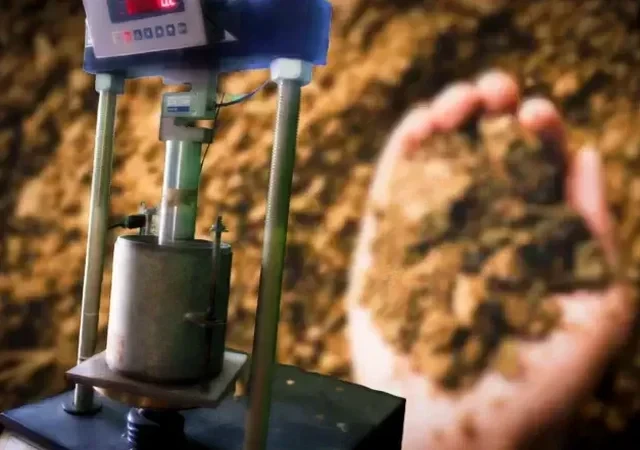
Tempe sits at an elevation of 1,170 feet in the Salt River Valley, where summer pavement surface temperatures routinely exceed 160°F. The Arizona Department of Transportation logs over 150,000 vehicles per day on the I-10 corridor through the city, which means the pavement structural section must withstand both thermal loading and heavy axle repetitions. A laboratory CBR test quantifies the bearing capacity of the compacted subgrade and base course materials before a single ton of asphalt is placed. We run the procedure inside a controlled soak tank for 96 hours to simulate the worst-case moisture condition that occurs during monsoon flooding, when the water table can rise rapidly in the basin fill soils. This data feeds directly into the AASHTO 1993 pavement design equation and the local Tempe Public Works standard specifications, ensuring the structural number matches real field conditions. For projects near Arizona State University or the emerging Rio Salado corridor, we often pair the soaked CBR with an on-site sand cone density test to correlate laboratory compaction curves with field density achieved during proof-rolling.
A soaked CBR of 3% versus 6% can double the required base course thickness in Tempe's high-temperature pavement environment.
Scope of work in Tempe Arizona
Working video
Risks and considerations in Tempe Arizona
A 35,000-square-foot warehouse project on the south bank of the Salt River had the structural design completed using an unsoaked CBR value of 12% from a preliminary geotechnical report. The contractor placed 8 inches of aggregate base over the prepared subgrade and began paving in October, just after the monsoon season ended. The following July, after three consecutive weeks of monsoon rainfall, the subgrade moisture content reached near-saturation levels and the in-situ bearing strength dropped to roughly 4%. Within 90 days, alligator cracking propagated across the truck loading docks, and the owner faced a $180,000 replacement of the pavement section. The engineering error was not running the soaked laboratory CBR test during the design phase. In Tempe's arid climate, the difference between dry and soaked strength is frequently a factor of two or three, particularly in the silty sands that dominate the valley fill. A soaked CBR value eliminates that false sense of security.
Our services
The laboratory CBR test is the centerpiece of our pavement materials evaluation program in the Phoenix metropolitan area. We support geotechnical consultants, civil contractors, and municipal agencies with testing packages that cover the entire pavement design workflow.
Soaked Laboratory CBR (ASTM D1883)
Three-point compaction and CBR penetration on prepared specimens submerged for 96 hours. Includes swell measurement, moisture-density curves, and the CBR family of curves at 10, 30, and 65 blows per layer.
Unsoaked CBR for Immediate Construction Control
Rapid unsoaked CBR determination for field compaction verification during earthwork operations. Results in 24 hours to support real-time density acceptance decisions on large grading projects.
Pavement Section Design Support Package
Combined laboratory CBR, grain-size analysis, and Atterberg limits testing with a pavement structural design memorandum referencing AASHTO 1993 and Tempe Public Works criteria.
Quick answers
What is the standard turnaround time for a laboratory CBR test in Tempe?
A standard soaked CBR test requires 96 hours of submersion plus compaction and penetration testing on the front and back end. We typically report results within 7 working days from sample receipt. Unsoaked CBR for construction control can be reported in 24 hours.
How much does a laboratory CBR test cost for a Tempe project?
A single-point soaked CBR test with compaction curve typically ranges from US$120 to US$190, depending on the number of compaction points and whether we need to run companion classification tests like grain-size or Atterberg limits on the same sample.
Why is the soaked CBR value more critical than unsoaked for Tempe pavements?
Tempe's monsoon season delivers intense rainfall that can saturate the subgrade within hours. The Salt River basin soils often contain silty sand with moderate capillarity, meaning moisture can migrate upward from a shallow water table. Soaked testing captures the worst-case bearing strength that controls long-term pavement performance.
When does the Tempe Public Works department require laboratory CBR testing?
The City of Tempe requires laboratory CBR values for all arterial and collector street pavement designs within the public right-of-way. Private commercial developments with more than 50 parking stalls or truck loading areas must also submit CBR results with the civil improvement plans.
Can you test aggregate base course materials with the CBR method?
Yes, ASTM D1883 applies to both soil subgrade and unbound granular base materials. For ABC Class 2 aggregate commonly used in Tempe, we compact the material in a 6-inch mold and run the CBR penetration test. Typical soaked CBR values for well-graded crushed aggregate in the Phoenix area range from 80% to 120%.