A mid-rise project along Apache Boulevard hit refusal with standard split-spoon samplers at 18 feet. The contractor called us out with the CPT rig, and within a few hours we mapped the entire subsurface profile down to 80 feet, identifying a dense caliche layer that the SPT simply couldn't penetrate. That's the reality of building in Tempe, where the Salt River's geological history has left behind complex interbedded deposits of cemented gravels, hardpans, and floodplain silts. Cone penetration testing provides continuous data that reveals these transitions without the gaps inherent in traditional drilling methods. For engineers working on the compact sites near Arizona State University or the expanding commercial corridors south of US 60, the CPT delivers sleeve friction, pore pressure, and tip resistance measurements that feed directly into bearing capacity calculations and liquefaction assessments. When we pair this data with a grain size analysis from disturbed samples, the stratigraphic picture becomes clear enough to optimize foundation design on the very first round of exploration.
Continuous CPT profiling through Tempe's interbedded caliche and river deposits eliminates the guesswork between SPT spoon intervals.
Scope of work in Tempe Arizona
Working video
Risks and considerations in Tempe Arizona
Tempe's urban expansion, from the agricultural grid of the early 1900s to the dense infill development of today, has placed new structural loads on soils that were once flood-irrigated farmland. The historic Salt River channel migration left behind lenses of loose saturated sand at depths between 15 and 35 feet across much of the city. When you combine that with the seismic hazard from the nearby San Andreas and local Basin and Range faults, liquefaction becomes a design-governing criterion for certain site classes. Skipping a CPT in favor of sparse SPT data means missing those thin, contractive sand seams that can trigger flow liquefaction under the design earthquake specified in ASCE 7 for Tempe's site class D and E profiles. We have seen projects where a single N-value from a spoon sample classified a layer as non-liquefiable, yet the continuous CPT trace showed a critical 8-inch silt pocket with a normalized tip resistance below 70. That level of detail changes the conversation from standard spread footings to ground improvement via stone columns or deep foundations, decisions that are far cheaper to make during design than after excavation reveals the problem.
Our services
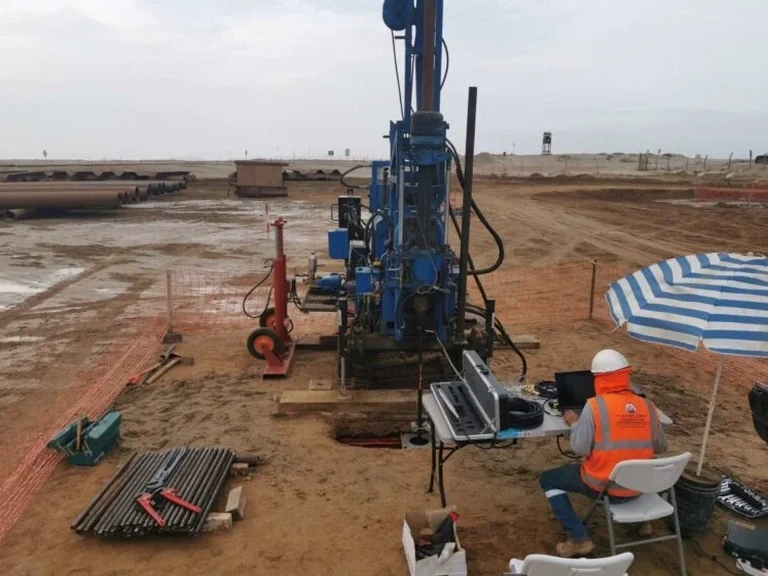
Our Tempe field team handles the full CPT workflow, from site access coordination in tight urban lots to final data interpretation using industry-standard soil behavior type charts. Every project includes dissipation tests to measure the in-situ coefficient of consolidation in clays and silts.
Seismic CPT (SCPT)
A geophone module added to the cone string measures shear wave velocity (Vs) every 1 meter during pauses in the push. Vs data is essential for ASCE 7 site class determination and liquefaction triggering analyses in Tempe's floodplain deposits.
Piezocone with Dissipation Testing
We stop the push at clay layers and record pore pressure decay over time. The t50 value from these dissipation curves gives us the coefficient of consolidation (cv), a parameter that takes weeks to obtain from lab consolidation tests.
CPT-Based Bearing Capacity Reports
Using the LCPC and Schmertmann methods directly from qc profiles, we calculate allowable bearing pressures for square, strip, and mat foundations. Reports include settlement estimates under service loads for the specific stratigraphy encountered on your Tempe lot.
Liquefaction Screening per ASCE 7
We run the Boulanger & Idriss (2014) CPT-based triggering procedure on every project in Tempe's mapped liquefaction zones. The output includes factor of safety against triggering and post-liquefaction reconsolidation settlement estimates for each soil layer.
Quick answers
What does a CPT test cost for a typical residential lot in Tempe?
For a standard single-family lot in Tempe, a CPT sounding to 50 feet with pore pressure measurements typically falls between US$190 and US$240 per vertical foot. That includes the rig mobilization within Maricopa County, the engineer's log with soil behavior type classification, and a summary of tip resistance and friction ratio. Deeper pushes or seismic cone modules add incremental cost. We always offer a fixed-price quote after reviewing the site address and planned depth so there are no surprises.
How does a CPT compare to standard SPT drilling in Tempe's soils?
In the cemented sands and caliche layers common across Tempe, the SPT often hits refusal or delivers highly disturbed samples that produce unreliable N-values. The CPT pushes continuously through these hard layers and records tip resistance (qc) at 10-millimeter intervals, which means we capture thin seams and transitions that a spoon sampler at 5-foot intervals would miss entirely. The trade-off is that the CPT does not recover a physical soil sample; for classification we rely on pore pressure response and friction ratio, correlated to local knowledge with Tempe's alluvial stratigraphy.
How deep can a CPT rig penetrate in Tempe's subsurface conditions?
Our 25-ton truck-mounted CPT rig can typically reach 80 to 100 feet in Tempe before encountering refusal on dense caliche or coarse river gravels. The actual refusal depth depends on the thickness and cementation of the caliche horizon, which varies significantly across the city: near Tempe Town Lake, we often reach 90 feet without issue, while areas closer to Papago Park may see refusal at 40 to 50 feet due to shallow bedrock-like conglomerates. We monitor push force in real time and stop when rod buckling risk approaches the safe limit.