Skipping the grain size test on a Tempe job is a fast way to get a compaction fail. We see it repeatedly on infill lots near the 101 where imported fill lands on native silty sand. The gradation doesn't match. The spec calls for 95% modified Proctor and the material won't lock. That delay costs more than the test. Our lab runs the full ASTM D422 and D6913 suite — sieve stack plus hydrometer — so you know the exact particle distribution before the first lift goes down. For deeper characterization we often pair it with Atterberg limits to flag plastic fines that swell with monsoon moisture, and sand cone density for field verification during compaction.
A missing D10 value on desert silty sand is the difference between a stable subgrade and a failed pavement section after one monsoon season.
Scope of work in Tempe Arizona
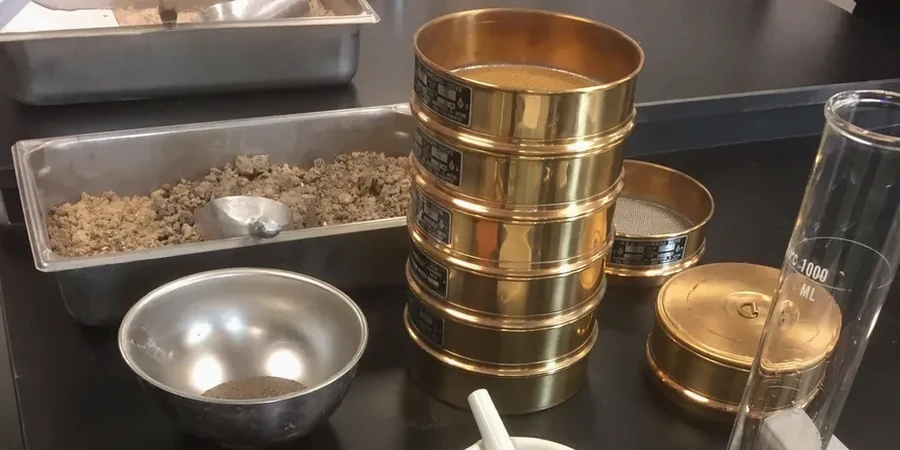
Our standard report gives you D10, D30, D60, the uniformity coefficient Cu, coefficient of curvature Cc, and the full USCS classification. We plot the curve against the IBC Chapter 18 gradation bands so you can flag gap-graded material immediately. For pavement subgrade work we often supplement with CBR testing to correlate gradation with bearing strength under saturated conditions.
Risks and considerations in Tempe Arizona
IBC Section 1803 requires soil classification for foundation design. In Tempe that means knowing exactly how much silt and clay is in the bearing stratum. The Salt River corridor has extensive lenses of low-plasticity silt — ML material that looks like sand in the field but collapses under load when wet. Without the hydrometer fraction you miss the clay-sized particles that control drainage and heave potential. The City of Tempe plan check will reject a soils report that stops at the #200 sieve. We learned that lesson on several multifamily projects east of ASU where the geotech had to resample because the fine fraction wasn't quantified. A full grain size curve with hydrometer keeps your permit moving. For sites near the Rio Salado channel we also recommend liquefaction assessment given the shallow groundwater and loose sands mapped in the USGS Quaternary database.
Our services
We run the full particle size package for Tempe contractors and geotechs. Every curve is plotted by an experienced technician — not auto-generated by software with no human review.
Full Sieve + Hydrometer Package
ASTM D6913 wash sieve and ASTM D422 hydrometer on the same sample. Complete gradation curve from gravel to clay, USCS classification, and Cu/Cc coefficients.
Rush Gradation for Compaction Hold Points
24-hour turnaround when the crew is waiting on a density test. We process the sample immediately and call you with the D-values before the written report.
Subgrade Verification Suite
Grain size analysis paired with Atterberg limits, modified Proctor, and CBR. One sample — four results. For road and pad prep in the Tempe industrial corridors.
Quick answers
How much material do you need for a grain size test?
For sand and silty sand — the most common soils in Tempe — we need about 500 grams. If there's gravel, 2 to 5 kilograms depending on maximum particle size. We offer sampling jars at our Phoenix lab; you can pick them up or we'll ship them. The key is a representative split. Grab a handful from the top of the pile and the results won't mean anything.
What does the test cost?
A full sieve plus hydrometer runs between US$90 and US$200 depending on whether we need to wash the fines and how many sieves are in the stack. Rush processing adds a surcharge. If you bundle it with Atterberg limits or a Proctor we can work out a package rate.
How long does the hydrometer portion take?
The sedimentation readings span 24 hours minimum per ASTM D422. We take readings at 2, 5, 15, 30, 60, 240, and 1440 minutes. That's why standard turnaround is 48 hours total — the hydrometer runs overnight while the sieve data is already processed. Rush service means we start the hydrometer the moment your sample arrives and report the next afternoon.
Do I really need the hydrometer or can I stop at the #200 sieve?
Tempe plan check will flag a report that only gives percent passing #200 without the clay fraction. If your site is mapped as Qyal — young alluvium — you almost certainly have silt and clay lenses that matter for drainage and bearing. Stopping at the sieve is fine for clean concrete sand. For anything going under a foundation or pavement, run the hydrometer.